
Beamship Dimensions and Capabilities
By Kåre Bergheim 2nd of March 2026
Beamship Dimensions and Capabilities
Beamships are flying machines with a minimum diameter of five meters, engineered for both planetary and interplanetary flight. Despite their compact size, these spacecraft possess immense range. The specific units operating within Earth's vicinity maintain a uniform diameter of seven meters and offer space for three people They are equipped with advanced technology for dimensional and hyperspace jumps, allowing them to traverse distances of countless light-years in a mere fraction of a second.
These ship types primarily serve for the transport of persons and materials, but also as operational aircraft for various task fulfillments, etc. They are piloted by only one person, whereby the steering of these ships is much easier, less exhausting, and less complicated than driving a car. They are absolutely crash-proof, because an automatic safety system with probability-factor calculation detects any faults days before damage occurs, allowing them to be rectified before they can manifest in appearance.
The safety device also corrects any incorrect control inputs instantly and automatically, making all faulty manipulations effectively irrelevant. These automatic safety systems, which operate using an artificial‑organic brain, are installed in all passenger‑carrying aircraft of every type—except for telemeter discs.
Summary of the 1977 Conversation with Semjase
In a 1977 discussion, Billy asks Semjase whether the term beamship originates from the use of a light‑emission drive and a tachyon drive. Semjase explains that this is not the case: although such drives exist, they are not beam‑propulsion systems. True beam‑drives were an older technology no longer in use for about 400 years, though the name beamship has been retained.
She notes that the craft she used during their first meeting in 1975 was still semi‑radial, which allowed Billy to see visible rays—these were simply highly concentrated beams of light, not propulsion beams. Her previous ship used an antigravity drive based on repulsion, suitable only for planetary flight, while the tachyon drive remained necessary for travel in free space. Her current ship uses an antimatter drive for free‑space travel, a technology developed more than 50,000 years earlier.
When Billy asks whether antimatter truly exists, Semjase confirms that it does. Their scientists discovered and researched it during the first millennium after the settlement of Erra. Before that, they only suspected the existence of anti‑forces but had not yet proven or harnessed them. Billy remarks that developing propulsion systems so quickly seems remarkable, and Semjase responds that sometimes the step from knowledge to capability is small.
Billy then asks about the weight of her current ship including the superstructure. Semjase explains that it is about 700 kilograms heavier than the previous model. Billy estimates this makes it roughly 1.5 tons, and Semjase confirms this—referring specifically to her current ship as of June 1977.
Protective shield around a beamship on the ground
As a rule, a beamship standing on the ground is secured by two protective shields. The outer protective shield is located at a distance of 500 m from the ship and has the effect of a circular guidance. This means: If an uninvited life form attempts to approach the ship consciously or unconsciously, then it is led astray by this invisible and imperceptible protective shield and guided around in a circle, whereby the beam ship cannot be reached.
The second protective shield is located 100 m away from the ship and produces the effect of a repulsion, according to the principle of two like‑oriented magnetic fields that repel each other. In this protective shield, however, the force is so great that it cannot be broken through even with the greatest application of force. Even a very good and powerful tank of the Centurion class would not be able to break through the protective shield, as the extraterrestrials told Billy. Projectiles of all kinds are likewise unable to penetrate this protective shield, because, like heavy armored vehicles, they too would be thrown back after a maximum penetration distance of 30 m.
Beamships are flying machines with a minimum diameter of five meters, engineered for both planetary and interplanetary flight. Despite their compact size, these spacecraft possess immense range. The specific units operating within Earth's vicinity maintain a uniform diameter of seven meters and offer space for three people They are equipped with advanced technology for dimensional and hyperspace jumps, allowing them to traverse distances of countless light-years in a mere fraction of a second.
These ship types primarily serve for the transport of persons and materials, but also as operational aircraft for various task fulfillments, etc. They are piloted by only one person, whereby the steering of these ships is much easier, less exhausting, and less complicated than driving a car. They are absolutely crash-proof, because an automatic safety system with probability-factor calculation detects any faults days before damage occurs, allowing them to be rectified before they can manifest in appearance.
The safety device also corrects any incorrect control inputs instantly and automatically, making all faulty manipulations effectively irrelevant. These automatic safety systems, which operate using an artificial‑organic brain, are installed in all passenger‑carrying aircraft of every type—except for telemeter discs.
Summary of the 1977 Conversation with Semjase
In a 1977 discussion, Billy asks Semjase whether the term beamship originates from the use of a light‑emission drive and a tachyon drive. Semjase explains that this is not the case: although such drives exist, they are not beam‑propulsion systems. True beam‑drives were an older technology no longer in use for about 400 years, though the name beamship has been retained.
She notes that the craft she used during their first meeting in 1975 was still semi‑radial, which allowed Billy to see visible rays—these were simply highly concentrated beams of light, not propulsion beams. Her previous ship used an antigravity drive based on repulsion, suitable only for planetary flight, while the tachyon drive remained necessary for travel in free space. Her current ship uses an antimatter drive for free‑space travel, a technology developed more than 50,000 years earlier.
When Billy asks whether antimatter truly exists, Semjase confirms that it does. Their scientists discovered and researched it during the first millennium after the settlement of Erra. Before that, they only suspected the existence of anti‑forces but had not yet proven or harnessed them. Billy remarks that developing propulsion systems so quickly seems remarkable, and Semjase responds that sometimes the step from knowledge to capability is small.
Billy then asks about the weight of her current ship including the superstructure. Semjase explains that it is about 700 kilograms heavier than the previous model. Billy estimates this makes it roughly 1.5 tons, and Semjase confirms this—referring specifically to her current ship as of June 1977.
Protective shield around a beamship on the ground
As a rule, a beamship standing on the ground is secured by two protective shields. The outer protective shield is located at a distance of 500 m from the ship and has the effect of a circular guidance. This means: If an uninvited life form attempts to approach the ship consciously or unconsciously, then it is led astray by this invisible and imperceptible protective shield and guided around in a circle, whereby the beam ship cannot be reached.
The second protective shield is located 100 m away from the ship and produces the effect of a repulsion, according to the principle of two like‑oriented magnetic fields that repel each other. In this protective shield, however, the force is so great that it cannot be broken through even with the greatest application of force. Even a very good and powerful tank of the Centurion class would not be able to break through the protective shield, as the extraterrestrials told Billy. Projectiles of all kinds are likewise unable to penetrate this protective shield, because, like heavy armored vehicles, they too would be thrown back after a maximum penetration distance of 30 m.
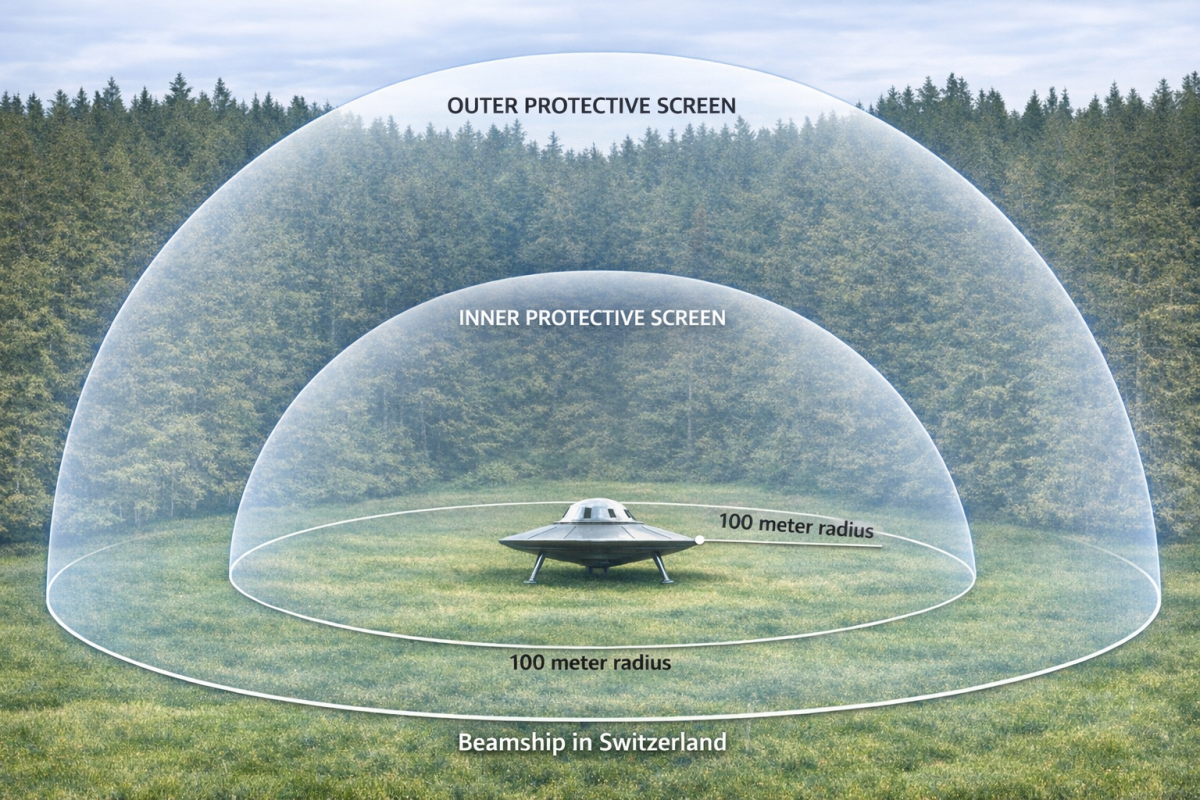
Above:
Shield Configuration (Landed): Featuring a dual-shield system with a 500m outer and 100m inner radius. Protective shielding is essential for beamships during landing, atmospheric flight, space travel, and underwater operations.
Image generated by Kåre Bergheim using Microsoft Copilot AI.
Image generated by Kåre Bergheim using Microsoft Copilot AI.
Beamship becoming a submersible - The pressure-protection shields
While our submarines rely on high-strength steel alloys for their outer hulls to withstand the enormous water pressure of the deep ocean, the protective shields of a beamship perform this function instead.
In 1987, Quetzal informed Billy that all their craft are equipped for underwater operations, as their pressure-protection shields allow for unlimited depth. He then took Billy on a demonstration journey where the beamship first flew into outer space, only to return to Earth and dive into the depths of both the Atlantic and Pacific Oceans. The following is Billy's description of that event::
"Quetzal then flies his beamship back to Earth and over the Atlantic, before descending into the depths of the ocean. We then hover above the spongy seabed while Quetzal slowly guides the beamship along, which has now become a submersible. On the exterior, the beamship glows with a radiant brilliance, illuminating the pitch-black darkness for a great distance around us. Little is said during this time, as I devote my full attention to everything I can see in the deep sea over the course of a full hour."
German original:
“Dann fliegt Quetzal sein Strahlschiff zur Erde zurück und über den Atlantik, um dann in die Tiefe des Meeres abzusinken. Dann schweben wir über dem schwammigen Grund und Quetzal bewegt das Strahlschiff, das ja jetzt zum Tauchschiff geworden ist, langsam dahin. Aussen leuchtet das Strahlschiff in strahlendem Glanz und erhellt die pechschwarze Finsternis in einem weiten Umkreis. Gesprochen wird dabei nicht viel, denn ich widme meine ganze Aufmerksamkeit allem, was ich während einer vollen Stunde in der Tiefsee sehen kann.”
The Mystery of the Spiral Landing Tracks
One of the most compelling physical aspects of the Beamship sightings involves the unique "swirl" patterns left in the grass at landing sites. In this dialogue, Billy Meier questions Semjase on the physics behind these marks, which remained unchanged for weeks.
"Quetzal then flies his beamship back to Earth and over the Atlantic, before descending into the depths of the ocean. We then hover above the spongy seabed while Quetzal slowly guides the beamship along, which has now become a submersible. On the exterior, the beamship glows with a radiant brilliance, illuminating the pitch-black darkness for a great distance around us. Little is said during this time, as I devote my full attention to everything I can see in the deep sea over the course of a full hour."
German original:
“Dann fliegt Quetzal sein Strahlschiff zur Erde zurück und über den Atlantik, um dann in die Tiefe des Meeres abzusinken. Dann schweben wir über dem schwammigen Grund und Quetzal bewegt das Strahlschiff, das ja jetzt zum Tauchschiff geworden ist, langsam dahin. Aussen leuchtet das Strahlschiff in strahlendem Glanz und erhellt die pechschwarze Finsternis in einem weiten Umkreis. Gesprochen wird dabei nicht viel, denn ich widme meine ganze Aufmerksamkeit allem, was ich während einer vollen Stunde in der Tiefsee sehen kann.”
The Mystery of the Spiral Landing Tracks
One of the most compelling physical aspects of the Beamship sightings involves the unique "swirl" patterns left in the grass at landing sites. In this dialogue, Billy Meier questions Semjase on the physics behind these marks, which remained unchanged for weeks.
- The Observation: Grass and brush are pressed into a counter-clockwise spiral toward the center, even though the landing gear plates do not rotate.
- The Longevity: The plants do not stand back up; they continue to grow horizontally along the ground for several weeks.
With reference to:
Plejadisch-plejarische Kontaktberichte, Gespräche, Block 2 (2003)
61st Contact Thursday, 29 July 1976, 00:43
Page 311
Partial quote
Billy
Good. We’ve noticed several times that the grass and brush in the imprints left by your and Quetzal’s landing struts are pressed down in a counter-clockwise spiral toward the center. We don’t understand this, because as far as I’ve seen, the landing gear plates themselves don’t rotate.
Semjase
148. That is very simple:
149. The circular surfaces of the landing struts—like the ship as a whole—vibrate in a spiral anti-gravity oscillation. As you correctly observed, this oscillation moves from the outside toward the center in a counter-clockwise direction.
150. The ship's underside possesses four such centers: three are located within the landing struts, while the fourth forms the ship’s center in the lower section.
Billy
Aha, that makes a lot of sense. But why is it that the grass and brush don't stand back up after a while, but instead continue to grow along the ground in that spiral pattern for weeks on end? We have tracks right now that are over four weeks old and haven't changed in the slightest. New grass and brush simply grow up between the stalks that were pressed down in that spiral shape.
Semjase
151. This, too, is very easy to explain:
152. The anti-gravity oscillation is significantly stronger than the planet’s own gravitational vibration. This causes a graviton-alteration within the plant life forms, which results in them being held down by a very minimal anti-gravity force—a counter-gravity. This counteracts the Earth's normal gravity, causing them to continue growing while lying in their spiral shape, as the plants themselves are not damaged or broken."
Billy
Now that I really don't understand. Based on what you're saying, wouldn't the plants have to repel themselves from the Earth, rather than being pressed down onto it even more?"
Semjase
153. You are thinking quite illogically, but then again, you lack the necessary knowledge of these things:
152. The anti-gravity oscillation is significantly stronger than the planet’s own gravitational vibration. This causes a graviton-alteration within the plant life forms, which results in them being held down by a very minimal anti-gravity force—a counter-gravity. This counteracts the Earth's normal gravity, causing them to continue growing while lying in their spiral shape, as the plants themselves are not damaged or broken."
Billy
Now that I really don't understand. Based on what you're saying, wouldn't the plants have to repel themselves from the Earth, rather than being pressed down onto it even more?"
Semjase
153. You are thinking quite illogically, but then again, you lack the necessary knowledge of these things:
154. In these cases, the anti-gravity oscillation is not situated beneath the plants, but rather on top of them. It therefore presses them down from above and repels against the gravitational force located above it, which is why the stalks remain lying down.
155. Naturally, the Earth's gravity itself still plays a significant role by making its gravitational pull effective."
Billy
I still don't get this stuff; it’s simply over my head.
Semjase
Do not be distressed, for even your earthly scientists are not yet capable of grasping these matters.
155. Naturally, the Earth's gravity itself still plays a significant role by making its gravitational pull effective."
Billy
I still don't get this stuff; it’s simply over my head.
Semjase
Do not be distressed, for even your earthly scientists are not yet capable of grasping these matters.
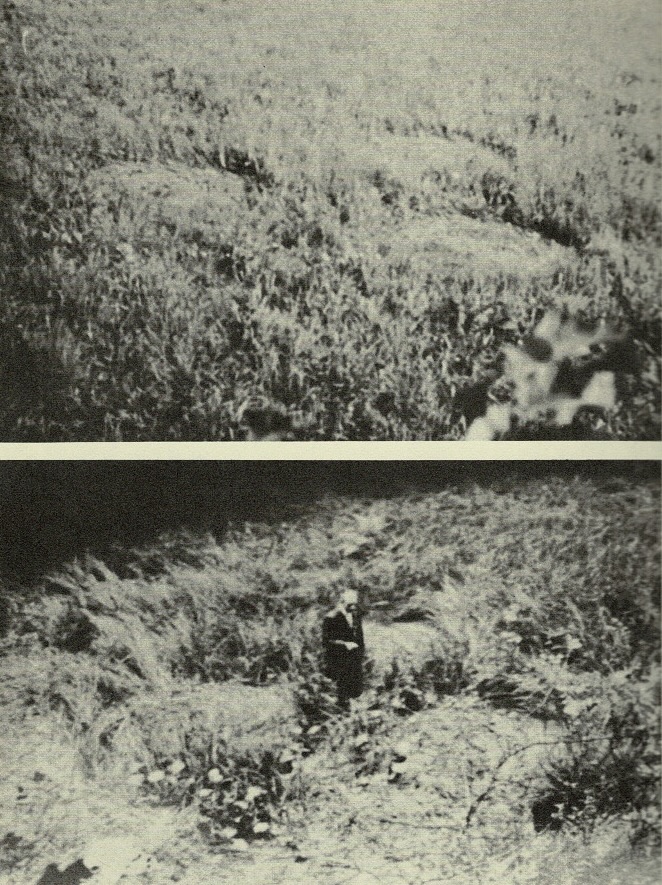
Above:
Investigation Report: Beamship Landing Tracks
Source: UFO Contact from the Pleiades: A Preliminary Investigation Report (1978/1982)(pp. 368–369)
Investigator: Lt. Col. Wendelle C. Stevens (Ret.) wrote:
Technical Observations
“These tracks always appear in threes as they are made simultaneously by the three landing vortices. The individual tracks are quite large, being about 2 meters in diameter by nearly 3 meters apart. The outside circumference inclosing all three tracks is about 7 meters, the diameter of the 3-man ship most frequently used for surface reconnaissance."
Vegetation Analysis
"The grass is observed to be swirled down from the outside to center in a counter-clockwise pattern, and is not broken off or crushed down except for larger stalks. The swirled down vegetation does not grow back up again, but continues to grow along the ground horizontally as though it had forgotten which way is up. New vegetation growing up in the landing track grows vertically however and does not seem to be affected.”
Technical Observations
“These tracks always appear in threes as they are made simultaneously by the three landing vortices. The individual tracks are quite large, being about 2 meters in diameter by nearly 3 meters apart. The outside circumference inclosing all three tracks is about 7 meters, the diameter of the 3-man ship most frequently used for surface reconnaissance."
Vegetation Analysis
"The grass is observed to be swirled down from the outside to center in a counter-clockwise pattern, and is not broken off or crushed down except for larger stalks. The swirled down vegetation does not grow back up again, but continues to grow along the ground horizontally as though it had forgotten which way is up. New vegetation growing up in the landing track grows vertically however and does not seem to be affected.”
German Original
Unter Bezugnahme auf:
Unter Bezugnahme auf:
Plejadisch-plejarische Kontaktberichte, Gespräche, Block 2 (2003)
Einundsechzigster Kontakt Donnerstag, 29. Juli 1976, 00.43 Uhr
Seite 311 Teil Zitat
Billy
Gut. - Verschiedentlich haben wir schon festgestellt, dass bei den Abdrücken der Landestützen deines und Quetzals Schiffes das Gras und Gestrüpp usw. entgegen dem Uhrzeigersinn spiralförmig nach innen zum Zentrum niedergedrückt ist. Das ist uns nicht verständlich, denn wie ich gesehen habe, drehen sich die Teller der Landestützen nicht.
Semjase
148. Das ist sehr einfach:
149. Die runden Flächen der Landestützen schwingen, wie das ganze Schiff, in einer spiralförmigen Antigrav-Schwingung, die, wie du richtig beobachtet hast, entgegen eines Uhrzeigerlaufes sich von aussen nach dem Zentrum bildet.
150. Die Schiffsunterseite hat vier solche Zentren, wobei drei sich in den Landestützen befinden, während die vierte das Schiffzentrum im unteren Teil bildet.
Billy
Aha, das klingt recht einleuchtend. Wie kommt es nun aber, dass das Gras oder Gestrüpp nicht wieder aufsteht nach einiger Zeit, sondern unverändert über Wochen hinweg in seiner spiralförmigen Bahn dem Boden entlang wächst? Wir haben ja jetzt Spuren, die über vier Wochen alt sind und die sich nicht im mindesten verändert haben. Das neue Gras und Gestrüpp usw. wächst ganz einfach zwischen den spiralförmig niedergeschwungenen Halmen wieder empor.
Semjase
151. Auch das ist sehr einfach zu erklären:
152. Durch die Antigrav-Schwingung, die sehr viel stärker ist als die Gravitationsschwingung des Planeten selbst, erfolgt eine Gravitonenveränderung in den pflanzlichen Lebensformen, so sie sich durch eine sehr minimale Antigravitationskraft, also eine Gegengravitation, selbst niederhalten und der normalen Gravitation der Erde entgegenwirken, so sie dann eben in ihrer Spiralform liegend weiterwachsen, denn die Pflanzenformen werden ja nicht durch ein Abbrechen beschädigt.
Billy
Das verstehe ich nun wirklich nicht, denn deiner Rede nach müssten die Pflanzen dann doch sich von der Erde abstossen und sich nicht erst recht auf diese niederdrücken.
Semjase
153. Du denkst sehr unlogisch, doch aber hast du ja keine Kenntnisse darüber:
154. Die Antigravschwingung liegt in diesen Fällen nicht unter den Pflanzen, sondern auf ihnen, so sie diese also von oben her niederdrückt und sich an der über ihnen liegenden Gravitationskraft abstösst, weshalb die Halme liegenbleiben.
155. Natürlich spielt dabei noch die Gravitationskraft der Erde selbst eine wichtige Rolle, die ihre Anziehung wirksam macht.
Billy
Ich verstehe das Zeugs trotzdem nicht, es geht einfach über meinen Verstand.
Semjase
156. Errege dich nicht, denn selbst die irdischen Wissenschaftler vermögen diese Dinge noch nicht zu erfassen.
References:
Stimme der WASSERMANNZEIT WISSENSWERTES aus Grenz- und Geisteswissenschaften und Ufologiestudien Nr. 1 September 1976 Page 13, 15 and 16
Plejadisch-plejarische Kontaktberichte, Gespräche, Block 2 (2003) 55th contact Monday, June 14, 1976, 10:37 a.m. Pages 219 to 220
Plejadisch-plejarische Kontaktberichte, Gespräche, Block 5 (2004) 218th contact May 30, 1987 Page 327
Plejadisch-plejarische Kontaktberichte, Gespräche, Block 2 (2003) 61st Contact Thursday, 29 July 1976, 00:43 Page 311 Partial quote
UFO contact from the Pleiades a Preliminary investigation report (1978/1982) p.368,369 By Lt. Col. Wendelle C. Stevens (Ret.) :
References:
Stimme der WASSERMANNZEIT WISSENSWERTES aus Grenz- und Geisteswissenschaften und Ufologiestudien Nr. 1 September 1976 Page 13, 15 and 16
Plejadisch-plejarische Kontaktberichte, Gespräche, Block 2 (2003) 55th contact Monday, June 14, 1976, 10:37 a.m. Pages 219 to 220
Plejadisch-plejarische Kontaktberichte, Gespräche, Block 5 (2004) 218th contact May 30, 1987 Page 327
Plejadisch-plejarische Kontaktberichte, Gespräche, Block 2 (2003) 61st Contact Thursday, 29 July 1976, 00:43 Page 311 Partial quote
UFO contact from the Pleiades a Preliminary investigation report (1978/1982) p.368,369 By Lt. Col. Wendelle C. Stevens (Ret.) :