
Beamship Sound Demonstration
By Kåre Bergheim 6th of March 2026
Beamship Sound Demonstration: How Shielding Technology Shaped Three Independent Accounts
The encounters involving Eva Bieri, Hans Schützbach, and Billy Meier represent three distinct perspectives on the same phenomenon: the operation of a Plejaren beamship and the effects of its advanced shielding technology. Understanding how these shields function is essential for understanding why each witness perceived the craft so differently.
A landed beamship normally maintains a dual-layer protective system: a 500‑metre deflection shield that subtly diverts people away, and a 100‑metre impenetrable shield that conceals the craft visually and acoustically. Only when these shields are partially or fully deactivated can a witness observe the ship directly.
In Eva Bieri’s case, the shields were opened completely to allow Billy to approach the craft. This rare circumstance enabled her to see the pulsating light and hear the characteristic whirring sound of the landed beamship.
In contrast, Hans Schützbach experienced a controlled demonstration designed specifically for audio recording. Here, the pilot Semjase kept the ship fully shielded except for a narrow, downward-facing channel. Through this opening, the powerful rotational sound escaped while the craft itself remained invisible from Hans’s position. Standing directly beneath the open channel, Billy was able to record the sound while observing the ship at close range.
These contrasting experiences—one visual and acoustic, the other acoustic only—form the foundation for the detailed witness statements that follow. After presenting both accounts, the article concludes with Wendelle C. Stevens’s formal investigative report, which provides the technical analysis of the beamship audio recordings.
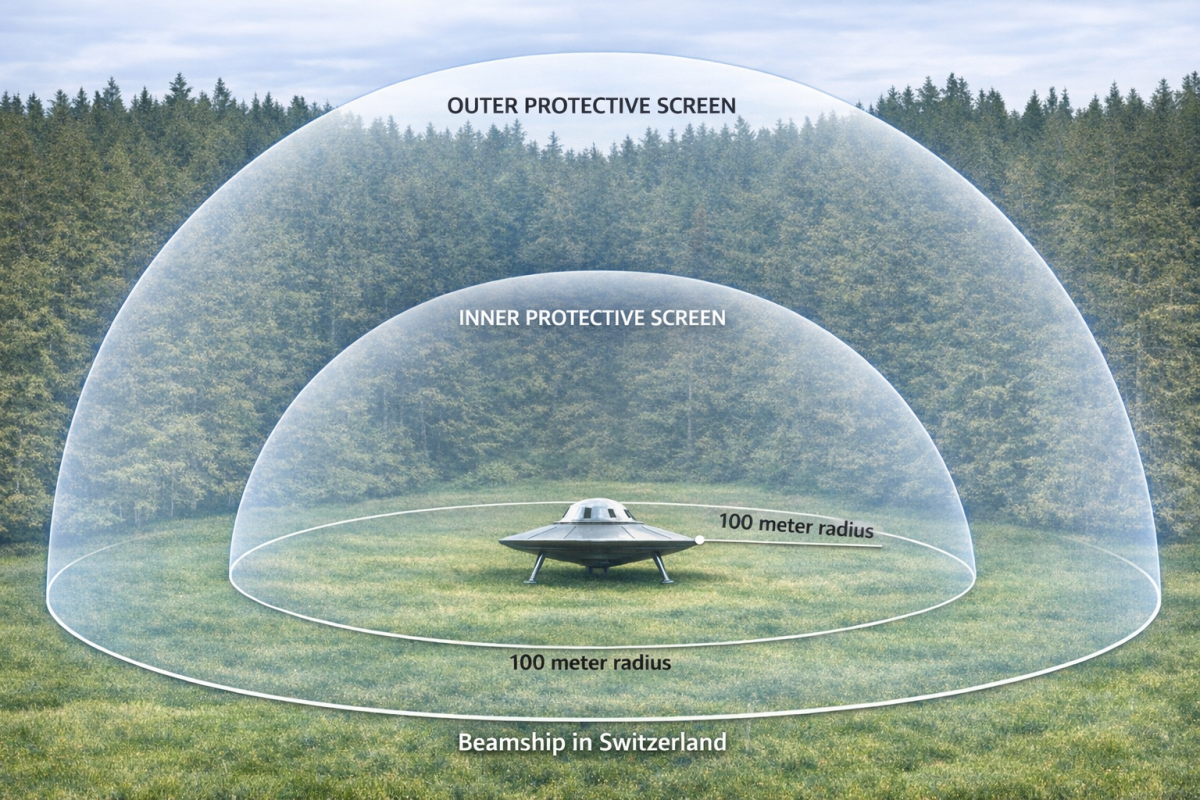
Illustration of the beamship’s dual-layer protective shielding, showing the 100‑metre inner screen and the 500‑metre outer deflection field.
This shielding system explains why different witnesses perceived the craft differently during the sound‑recording events.
Illustration by Kåre Bergheim, created with Microsoft Copilot.
Billy’s Contact of 1 June 1981 – Witness Account by Eva Bieri
—-
🌙 Sunday Evening
It was Sunday evening and they had been watering the gardens until almost midnight because it had been very hot for days and there had been no rain. For her part, Eva was on night watch from midnight to 3 a.m. and was sitting on the sofa in front of the house. Billy was still walking around a bit and looking at everything.
---
🌌 Rolf Still Awake
Rolf Wächter was also still awake and sat on the patio. As Billy passed by the sofa where Eva was sitting, he said to her that he had a feeling as if he still had to go to a contact tonight. When he then walked toward the nearby forest, Eva naturally thought that he was going on foot to his contact location. So she watched him until he had disappeared and then looked into the beautiful, star‑studded sky.
---
🔊 A Faint Yet Distinct Noise
After about 10 minutes, Eva heard a very faint yet distinct noise from the direction of the forest where Billy had disappeared. Rolf heard it as well; he stood up, came over to her, and asked where Billy was. Eva answered that she didn’t know and told him he should finally go to bed.
He only asked if she had also heard the sound. “Of course,” Eva answered him; by then, she had recognised the sound as the whirring of Semjase’s or Quetzal’s spaceship—something she knew quite well because she had been present the year before during tape recordings when Billy and several others were able to record the sound of Semjase’s beamship, as it was not shielded against the escaping sound.
But Eva didn’t necessarily want to tell Rolf that. So he went into the house, and she thought he had actually gone to bed. But she was mistaken, for after another 20 minutes, Billy came back and asked her who had walked along the little path in the Whirring Meadow because he had seen someone while he was sitting at the edge of the forest.
---
🚶♂️ The Contact Delayed
Of course, it could only have been Rolf, who had gone out again through the back door to see what had sounded so suspicious. Thus, the contact did not yet take place. Instead, Billy woke up his wife Popi. She had to continue the watch because Eva now had to drive Billy to the contact location.
---
🚗 The Drive to Sädelegg
They set off, but the drive did not last long, as it only went as far as Sädelegg, where Billy had already had contact several times. They got out together and looked around, when Billy suddenly said: “Look, do you see something at the edge of the forest over there?” Eva looked and indeed spotted, at a distance of about 300 metres, a large, brightly shimmering light which shone sometimes more and sometimes less intensely. It was Quetzal’s ship.
---
✨ Waiting at the Parking Lot
Billy said that Eva should sit on the bench under the tree at the parking lot—and then she didn’t move from the spot as Billy marched toward the light. After about two minutes, Eva heard that well‑known whirring of Quetzal’s ship again, and she even thought to herself silly me, he was doing it on purpose just to give her something to grin about. That was not the case, of course—logically not. Billy later explained to her that whenever he boards, the ship’s noise shielding is sometimes opened too early, which allows the whirring to be heard.
Anyway, Eva stayed rooted to her spot and didn’t dare take a single step forward, because she knew that the Pleiadians did not like it at all when someone approached them.
---
🌲A Quiet Night, Except for a Roebuck
Every now and then Eva looked around to see whether anyone was approaching and if everything remained quiet, but all was quite peaceful; nothing could be heard except for the barking of a roebuck that had apparently been startled by something. Despite everything, she had to yawn heartily a few times before Billy returned after 20 minutes. When she heard his footsteps, Eva watched Quetzal’s ship intently, which had been glowing continuously during the past 20 minutes, but she saw nothing more, except that the ship’s intense glow suddenly just went out.
---
🚘 Returning Home
When Billy returned, they got back into the car and drove home, where Eva continued her night watch, which she extended until 4:00 a.m. because she still had all kinds of office work to do.
---
📚 Publication and Sources
Eva’s account was first published in Stimme der Wassermannzeit No. 37, and later included in the Zeugenbuch (2001), pages 274–275, under the title Billys Kontakt vom 1. Juni 1981.
Good Friday, 16 April 1976 – Witness Account by Hans Schutzbach
🌤️ A Spring Day and a Planned Recording
As on the days prior, Billy once again had the opportunity on this Good Friday 1976 to record the whirring of Semjase’s beamship on tape. Since Hans happened to be present, it was decided to take advantage of the glorious spring day and head out with the whole family—Billy ahead leading the way on his moped, and the others following behind in the car. Outside Hinwil, they had to stay behind at a quiet edge of the forest and wait for more than an hour before Billy came driving across the forest and asked them to come with him.
---
🌿 Crossing the Nature Reserve
Following this, they crossed the nature reserve to its other end. Finally, they turned into a restricted small road, and then they were at their destination. Once again they had to stay behind, while Billy walked about 100 metres further. Now he was in the middle of a reed‑grass‑covered clearing, which slopes slightly downwards towards the centre. Here he stopped and set up his tape recorder, holding the microphone up into the air.
---
🔊 A Strange Whirring Above Billy
Then something very strange happened: above Billy, at a height of at least 30 metres, a strange whirring and whistling sound began, which constantly changed pitch. The sounds bore a distant resemblance to the whistling of a jet engine and a lathe squeaking while machining a workpiece, but with a slight imbalance in the tone.
Then Billy held his right arm above him in a circular motion, and matching this, the pitch spiralled higher. It soared upward, almost beyond the range of hearing, and sank deep once more; the whirring sound seemed to slow down. Two frequencies constantly oscillated into each other, flowed together and separated again. Clear and loud, only sometimes torn apart by the wind, the sounds reached them.
---
😮 Captivated by the Sound
Hans was so captivated by the sounds coming from the air that he couldn’t understand why Billy suddenly made an angry gesture, whereupon the whirring cut off after exactly 10 minutes. But now they had uninvited listeners: a VW Beetle had parked behind Hans’s Döschwo (Citroën 2CV).
Its two occupants looked toward Billy with interest, one of them even through binoculars. From another direction, a man with a German Shepherd on a leash was marching up, while from a third side, two motorcyclists drove up. They all seemed to have the clearing, over which the buzzing sound hung in the air, as their goal—just like a figure that was half‑hidden by trees. These people had simply appeared out of nowhere.
The driver of the car was the area’s game warden and forest ranger. His companion, like the one with the dog, were plainclothes police officers. Billy asked them what they were doing there, but apart from an evasive answer, nothing else could be learned. This sudden gathering of people seemed striking to them, because when they arrived here, there was no one else in the area.
One explanation for this could be that Mr. Meier is being followed whenever he goes out into the terrain.
---
👀 Public Curiosity and the Beamship’s Sound
Many people in Hinwil are interested in UFOs and would love to catch a glimpse of one through Billy. Yet people do not approach him directly; perhaps they have too much respect for him? In any case, this assumption was reinforced by the recent episode. Normally, Billy does not hear the buzzing continuously, but only as a short buzzing sound when the beamship arrives and departs.
In this instance, however, it was a deliberate demonstration for the purpose of making audio tape recordings. The sound stems from the rotation of the ship’s outer sections; its interaction with the air produces the specific noise, which fluctuates based on the rotational speed. This is only audible when the ship is unshielded. In their particular case, the craft was not visible from the side—and thus from Hans’s vantage point.
---
🛸 How the Sound Reached the Ground
How is that possible? The highly advanced technology available to Semjase enables her to shield the ship sector by sector. That is why this time a narrow channel to the ground remained open, through which the buzzing could be heard. Further down, the sound was able to spread out sideways. If Hans had the impression that the noise was coming from a height of about 30 metres, it was an illusion; Billy later spoke of a height of 50 metres. In any case, he saw the object, which became increasingly transparent to him the higher the pitch rose.
---
🔁 A Revealing Test Two Days Later
Two days later, they conducted the following revealing test: they returned to the site and played back the recording at full volume. This time, however, the sound clearly originated from the ground—it came undeniably from the loudspeaker and sounded quite weak. They therefore had to move more than halfway closer to the device to hear the sound at roughly the same volume as on Good Friday. Now it was possible to identify the small device as the source of the sound, whereas before it had seemed to have been about 7 metres in diameter.
---
✔ A Final Observation
One final point: when Hans heard the whirring, he looked very closely. There was no speaker hanging from a tight string, nor was there a balloon in the air that could have been responsible for the sound. Thus, everything about it was genuine. This may be hard to understand for someone who refuses to look into these matters. And yet, reality must be given the credit it deserves.
---
👥 Additional Witnesses
Additional witnesses: Kalliope Meier, Gilgamesha, Atlantis, and Methusalem Meier (possibly Amata Stetter)
---
📚 Publication and Sources
Hans’s account was first published in the first edition of the Semjase‑Kontakt‑Berichte in 1976, and later included in the Zeugenbuch (2001), pages 64–68, under the title Karfreitag, 16. April 1976 – Das Sirren des Strahlschiffes von Semjase.
—-
🌙 Sunday Evening
It was Sunday evening and they had been watering the gardens until almost midnight because it had been very hot for days and there had been no rain. For her part, Eva was on night watch from midnight to 3 a.m. and was sitting on the sofa in front of the house. Billy was still walking around a bit and looking at everything.
---
🌌 Rolf Still Awake
Rolf Wächter was also still awake and sat on the patio. As Billy passed by the sofa where Eva was sitting, he said to her that he had a feeling as if he still had to go to a contact tonight. When he then walked toward the nearby forest, Eva naturally thought that he was going on foot to his contact location. So she watched him until he had disappeared and then looked into the beautiful, star‑studded sky.
---
🔊 A Faint Yet Distinct Noise
After about 10 minutes, Eva heard a very faint yet distinct noise from the direction of the forest where Billy had disappeared. Rolf heard it as well; he stood up, came over to her, and asked where Billy was. Eva answered that she didn’t know and told him he should finally go to bed.
He only asked if she had also heard the sound. “Of course,” Eva answered him; by then, she had recognised the sound as the whirring of Semjase’s or Quetzal’s spaceship—something she knew quite well because she had been present the year before during tape recordings when Billy and several others were able to record the sound of Semjase’s beamship, as it was not shielded against the escaping sound.
But Eva didn’t necessarily want to tell Rolf that. So he went into the house, and she thought he had actually gone to bed. But she was mistaken, for after another 20 minutes, Billy came back and asked her who had walked along the little path in the Whirring Meadow because he had seen someone while he was sitting at the edge of the forest.
---
🚶♂️ The Contact Delayed
Of course, it could only have been Rolf, who had gone out again through the back door to see what had sounded so suspicious. Thus, the contact did not yet take place. Instead, Billy woke up his wife Popi. She had to continue the watch because Eva now had to drive Billy to the contact location.
---
🚗 The Drive to Sädelegg
They set off, but the drive did not last long, as it only went as far as Sädelegg, where Billy had already had contact several times. They got out together and looked around, when Billy suddenly said: “Look, do you see something at the edge of the forest over there?” Eva looked and indeed spotted, at a distance of about 300 metres, a large, brightly shimmering light which shone sometimes more and sometimes less intensely. It was Quetzal’s ship.
---
✨ Waiting at the Parking Lot
Billy said that Eva should sit on the bench under the tree at the parking lot—and then she didn’t move from the spot as Billy marched toward the light. After about two minutes, Eva heard that well‑known whirring of Quetzal’s ship again, and she even thought to herself silly me, he was doing it on purpose just to give her something to grin about. That was not the case, of course—logically not. Billy later explained to her that whenever he boards, the ship’s noise shielding is sometimes opened too early, which allows the whirring to be heard.
Anyway, Eva stayed rooted to her spot and didn’t dare take a single step forward, because she knew that the Pleiadians did not like it at all when someone approached them.
---
🌲A Quiet Night, Except for a Roebuck
Every now and then Eva looked around to see whether anyone was approaching and if everything remained quiet, but all was quite peaceful; nothing could be heard except for the barking of a roebuck that had apparently been startled by something. Despite everything, she had to yawn heartily a few times before Billy returned after 20 minutes. When she heard his footsteps, Eva watched Quetzal’s ship intently, which had been glowing continuously during the past 20 minutes, but she saw nothing more, except that the ship’s intense glow suddenly just went out.
---
🚘 Returning Home
When Billy returned, they got back into the car and drove home, where Eva continued her night watch, which she extended until 4:00 a.m. because she still had all kinds of office work to do.
---
📚 Publication and Sources
Eva’s account was first published in Stimme der Wassermannzeit No. 37, and later included in the Zeugenbuch (2001), pages 274–275, under the title Billys Kontakt vom 1. Juni 1981.
Good Friday, 16 April 1976 – Witness Account by Hans Schutzbach
🌤️ A Spring Day and a Planned Recording
As on the days prior, Billy once again had the opportunity on this Good Friday 1976 to record the whirring of Semjase’s beamship on tape. Since Hans happened to be present, it was decided to take advantage of the glorious spring day and head out with the whole family—Billy ahead leading the way on his moped, and the others following behind in the car. Outside Hinwil, they had to stay behind at a quiet edge of the forest and wait for more than an hour before Billy came driving across the forest and asked them to come with him.
---
🌿 Crossing the Nature Reserve
Following this, they crossed the nature reserve to its other end. Finally, they turned into a restricted small road, and then they were at their destination. Once again they had to stay behind, while Billy walked about 100 metres further. Now he was in the middle of a reed‑grass‑covered clearing, which slopes slightly downwards towards the centre. Here he stopped and set up his tape recorder, holding the microphone up into the air.
---
🔊 A Strange Whirring Above Billy
Then something very strange happened: above Billy, at a height of at least 30 metres, a strange whirring and whistling sound began, which constantly changed pitch. The sounds bore a distant resemblance to the whistling of a jet engine and a lathe squeaking while machining a workpiece, but with a slight imbalance in the tone.
Then Billy held his right arm above him in a circular motion, and matching this, the pitch spiralled higher. It soared upward, almost beyond the range of hearing, and sank deep once more; the whirring sound seemed to slow down. Two frequencies constantly oscillated into each other, flowed together and separated again. Clear and loud, only sometimes torn apart by the wind, the sounds reached them.
---
😮 Captivated by the Sound
Hans was so captivated by the sounds coming from the air that he couldn’t understand why Billy suddenly made an angry gesture, whereupon the whirring cut off after exactly 10 minutes. But now they had uninvited listeners: a VW Beetle had parked behind Hans’s Döschwo (Citroën 2CV).
Its two occupants looked toward Billy with interest, one of them even through binoculars. From another direction, a man with a German Shepherd on a leash was marching up, while from a third side, two motorcyclists drove up. They all seemed to have the clearing, over which the buzzing sound hung in the air, as their goal—just like a figure that was half‑hidden by trees. These people had simply appeared out of nowhere.
The driver of the car was the area’s game warden and forest ranger. His companion, like the one with the dog, were plainclothes police officers. Billy asked them what they were doing there, but apart from an evasive answer, nothing else could be learned. This sudden gathering of people seemed striking to them, because when they arrived here, there was no one else in the area.
One explanation for this could be that Mr. Meier is being followed whenever he goes out into the terrain.
---
👀 Public Curiosity and the Beamship’s Sound
Many people in Hinwil are interested in UFOs and would love to catch a glimpse of one through Billy. Yet people do not approach him directly; perhaps they have too much respect for him? In any case, this assumption was reinforced by the recent episode. Normally, Billy does not hear the buzzing continuously, but only as a short buzzing sound when the beamship arrives and departs.
In this instance, however, it was a deliberate demonstration for the purpose of making audio tape recordings. The sound stems from the rotation of the ship’s outer sections; its interaction with the air produces the specific noise, which fluctuates based on the rotational speed. This is only audible when the ship is unshielded. In their particular case, the craft was not visible from the side—and thus from Hans’s vantage point.
---
🛸 How the Sound Reached the Ground
How is that possible? The highly advanced technology available to Semjase enables her to shield the ship sector by sector. That is why this time a narrow channel to the ground remained open, through which the buzzing could be heard. Further down, the sound was able to spread out sideways. If Hans had the impression that the noise was coming from a height of about 30 metres, it was an illusion; Billy later spoke of a height of 50 metres. In any case, he saw the object, which became increasingly transparent to him the higher the pitch rose.
---
🔁 A Revealing Test Two Days Later
Two days later, they conducted the following revealing test: they returned to the site and played back the recording at full volume. This time, however, the sound clearly originated from the ground—it came undeniably from the loudspeaker and sounded quite weak. They therefore had to move more than halfway closer to the device to hear the sound at roughly the same volume as on Good Friday. Now it was possible to identify the small device as the source of the sound, whereas before it had seemed to have been about 7 metres in diameter.
---
✔ A Final Observation
One final point: when Hans heard the whirring, he looked very closely. There was no speaker hanging from a tight string, nor was there a balloon in the air that could have been responsible for the sound. Thus, everything about it was genuine. This may be hard to understand for someone who refuses to look into these matters. And yet, reality must be given the credit it deserves.
---
👥 Additional Witnesses
Additional witnesses: Kalliope Meier, Gilgamesha, Atlantis, and Methusalem Meier (possibly Amata Stetter)
---
📚 Publication and Sources
Hans’s account was first published in the first edition of the Semjase‑Kontakt‑Berichte in 1976, and later included in the Zeugenbuch (2001), pages 64–68, under the title Karfreitag, 16. April 1976 – Das Sirren des Strahlschiffes von Semjase.

Billy Meier and investigator Lt. Col. Wendelle C. Stevens reviewing the beamship sound recordings during the field investigation.
In this scene, Billy explains the circumstances under which the audio was captured, including the presence of witnesses such as Eva Bieri, Hans Schützbach, and others who heard the beamship’s characteristic sound during the recording sessions.
Reference: Still from the documentary “CONTACT: An Investigation Into the Extraterrestrial Experiences of Eduard Meier.”
Note: The chapter headings are mine; the text that follows is quoted exactly as written in the original investigator’s report.
The fact that the witness in this rare case has also recorded the sounds of the spacecraft in flight offers another exceptional opportunity for analysis. And we will resort to computer science to give us our best assessment here too. We pick out the various tones and all of their parts and isolate them for study. From them we can determine the frequency and amplitude of the sound waves, and many of the characteristics of the emitter or emitters. We can even tell a little about how the sound is produced and what kind of sound it is.
We will then program the computer to look for doppler variations on the basic tones and convert the rate of change to rate of motion. Now we will be able to tell how fast the object was moving with respect to the sound recorder and by adding time we can also get changes in distance, which we can then check against the witness’s original statements about the contact.
After removing scratch and extraneous noise on the tape, the computer showed the sound recorded to be composed of a mix of 32 very narrow frequencies, 24 in the audible range and another 8 out of the range of the human ear all perfectly band-locked together. These frequencies showed a regular spacing on a curved plot of an ever ascending scale and all 32 of them were continuously emitted by separate emitters. Doppler shift, if any, was so small that it was effectively obscured by a regular fluctuation in amplitude on all of the frequencies. Changing amplitude produces an effect similar to doppler shift and when the rate of change is small enough it is difficult to distinguish. This bears out the witnesses testimony that the ship was hovering or moving slowly in his near vicinity. The “beat” heard is an effect produced by the fluctuating amplitude. According to the witness, a dog heard barking throughout most of the recording, was pushing his head in the grass and trying to put his paws over his ears. The dog, about 300 feet away, may have been reacting to some of the frequencies to which he may have been particularly sensitive.
It is estimated that to duplicate this sound one would need a minimum of 8 very expensive synthesizers and highly sophisticated mixing equipment costing no less than $100,000.00 on todays market. There is no way they could be perfectly band-locked together.
---
INNOVATIVE ANALYSIS METHODS
As with the photo analysis, in examining the sounds of the Pleiadian spacecraft recorded in Switzerland by Eduard Meier, we ended up resorting to innovative techniques.
A Micro programmer working late at night (02:00) was sitting at the computer designing software systems for electronic funds transfer procedures when all of a sudden he began typing instructions for making the digital synthesizer circuits, and in 20 minutes he typed out all the Fourier transforms and everything for converting sound to digital logic. Four months later he built a prototype at his home, where Jim Dilettoso ran into him and explained how to convert the digital Fourier transforms into analog signals for music.
This was previously considered impossible, that one can not digitally process sound because digital electronics have no analog signal going on inside. There was no output transformer to convert digital clicks into some kind of audio signal. Dilettoso helped him build a digital to analog converter which was used to feed the data into an analog oscillator which then produced the sound. Mr. Chowning at Stanford University, who had been working on something similar for 10 years, said “We can do it but we can’t do it in real time”. He thought that maybe in 10 hours of programming it might be possible to set up Bethoven’s Sonata. But the new hook-up gave results in real time. One could sit down and play the buttons like a keyboard.
---
SYNTHESIZERS AND SUB‑AUDIO FREQUENCIES
Discussions then turned to synthesizers and how they could be used to generate VERY FINE transduced waves in nanohertz (billionths of a frequency) that would do very specific things. What if a signal for a theta wave, an emotional mandala transfer is 6.02975841 Hz? How would one get that precise? Well, all we do is punch the necessary buttons and plug the output into the newly invented sound-spheres which reproduce the sounds perfectly, including sub-sonics, and transduce it out there.
So when Dilettoso first came into contact with the sounds of the spacecraft recorded by Eduard Meier he took them into the laboratory working on these problems and asked them to tell him what these sounds were.
They proceeded to make some tests on the sounds in the audible range, from 20 Hz, deep base, to 20,000 Hz, high limits of human audio hearing. They found a harmonic formula in there. In that recording all the frequencies are present at the same time. By extending the formula they could conjecture the frequencies that are out of the human hearing range, above and below, by just plotting a graph. They found that there are 32 frequencies present simultaneously, 24 in the audible range and 8 out. What appears to be a sweeping sound is not a band width sweep – still remain present but their relative amplitude decreases as well as volumn. This could be further analyzed with a digital frequency counter if one had been available.
Now in order to come up with a formula for production of a sound like this recording, because some of the frequencies are very odd-ball, the person would have to have a very sophisticated electronics music laboratory. They couldn’t do it with just a collection of synthesizers. This is why it would be very difficult to produce this sound artificially.
---
LIMITATIONS OF SYNTHESIZERS
First of all, the most advanced synthesizers on the market only have 4 oscillators, which means that he would need at least 8 synthesizers. The synthesizers do not go into sub-audible ranges. We can only detect these ranges by using sound spheres to transduce the sound, and the tape has harmonics between the 24 audible frequencies which are overtones. Let’s say that a 10 Hz signal will have overtones of 20, 40 and 80. But if we do not have an 80 cycle signal in the audible range, yet we detect a trace of it, that tells us that it is a natural harmonic of a lower frequency. So that is why we can say that we believe that there are sub-harmonics, sub-audible frequencies, being generated. It is because we pick up their overtones and that is what we base our belief upon. This means that there are 32 sound sources that are producing pure sine waves, which makes them accessible to human technology – that is pure rings. sound waves propagate like ripples in water.
---
DOPPLER SHIFT AND AMPLITUDE EFFECTS
We could not measure doppler shift accurately because, as a frequency would go out of range where we should be hearing doppler, which is a wave length shift, it was obscured by the amplitude change and the different harmonics reaching it at different times. If the amplitude of various harmonics is changing in a relative complement to the distance it is moving away there would be no apparent doppler effect. The ascending and descending strength of the amplitude obscured the frequency changes.
From the above we can tell that there are 32 fixed wavelengths, very pure tones of narrow width and equal spacing being generated simultaneously. And in a formula of time the amplitude of some of the frequencies increases as the amplitude of others decreases. There is some relationship between the frequencies and the time or rate-of-change. The amplitude increases by about 50 decibles and then decreases by about 40, producing the beat heard in the audible sound. Where the aircraft sound and the spacecraft sound are heard together it was possible to determine that they were in fact recorded simultaneously. There was no evidence of sound-on-sound dubbing. All frequencies were very pure and were very stable, and were regularly spaced along the frequency scale.
---
MECHANICAL SOUND ANALYSIS BY ROBIN L. SHELLMAN
The Pleidian spacecraft sounds recorded in Switzerland by Mr. Eduard Meier were also turned over to Mr. Robin L. Shellman, a highly trained sound technician working on very sophisticated sound programs that cannot be discussed here, who performed a mechanical sound analysis intended to reveal the nature of the sounds recorded as compared to the scientific analysis of the wave length and amplitude and all the characteristics of the wave, the emitters, and the power behind the sound production.
Shellman performed his audio analysis on 20 April 1980 using a spectrum analizer built by Spectro Dynamics of San Diego, California. This processor has a demodulation mode and it also has an analysis range window from 10 Hertz to 20 Kilohertz, and a translator mode so one can select the center frequency with a given window. Demodulation indicated a rotating device at approximately 249.6 rpm by a modulation rate of 4.16 Hertz. The tape was slowed to 1/4th speed and a weaker audible beat was detected at 4 times this rate or 9098.4 rpm. This weaker beat may be caused by a rotating device passing by four individual electrical or magnetic fields. The same result could be expected by four vanes or protrusions on a rotating device as it was rotated in the air, much like the beat heard from the blades of an electric fan.
A brief spectrum analysis from zero to 5 Kilohertz, using a time versus frequency display, indicated a variable high speed device rotating from 29,500 rpm to as high as 59,400 rpm, and was only evident when the slower beat was heard. Both sounds seemed to be directly related however the slower one did not change its rate throughout the recorded sample. The high speed device would start from a fundamental frequency of 520 Hertz and ascend in steps to 990 Hertz and then using the same frequency steps descend back down to 520 Hertz. The frequency steps were a little rough because the bandwidth of the tonals at times seemed to blend together. The group of tonals surrounding 520 Hertz would fade out together at 520 and then reappear at 600 and fade out together again until 720 and fading again but coming back very strong at 990 Hertz. It did exactly the same thing as it shifted back down the band, using the same Hertz thresholds. It would remain stable for a short period of time and then the shift would begin all over again.
At one point in the sound cut the spacecraft was evidently motionless as it emitted a low throbbing beat, and then the high speed rotating device came on and the sound rose rapidly to a high pitch whining crescendo in the upper 50,000 rpm or better realm. At the same time the slower 249.6 rpm device again became audible. The whine was produced by the high speed device coming in at around 29,000 rpm and speeding up to above 59,000 rpm. Perhaps the rotating device is suspended in a magnetic field and has no bearing friction at all! This certainly is no sound that could be produced by any conventional machinery known to Earth technology.
—
NAVAL UNDERSEA SOUND CENTER ANALYSIS
Shellman took the sound recording to another laboratory, the Naval Undersea Sound Center at Groton, where he was joined by two other researchers, Mr. Steven Williams and Mr. Howard Ilson, both from NUSC, who also helped in obtaining pictorial display data from the equipment used. They first tested to identify all sounds not originating from the UFO. Three conventional aircraft were detected, two of which were propeller driven. The third was a single-engine jet. Each aircraft was identified and frequency graphs were prepared.
The first aircraft identified was a “Pilatus Porter”, a single engine turbo-prop light reconnaissance plane. The frequencies gradually decreased toward the left of the visual display chart. This was caused by the plane’s movement, and is referred to as “Doppler Shift”. During this period, the plane was showing 45-50 knots of range rate, which demonstrated the actual movement of the aircraft with respect to the recorder.
The second aircraft was determined to be a Junkers Ju-52, an older tri-motored transport aircraft built in 1933. Again, the frequencies from the plane’s engines demonstrated linear motion detected from the “Doppler Shift”. This aircraft was moving away, turned slightly and continued on its way out of the recording.
The third aircraft was a “mirage” jet fighter. The jet was fairly distant, and no distinct frequency change could be detected on this portion of the recorded sounds. No evidence of “Doppler” was detected due to the aircraft’s range. No unusual characteristics were detected concerning the conventional aircraft sounds recorded. The following infrequent additional background noises were detected:
1.Small dog barking.
2.European Police Siren.
3.Crow (cawing).
4.Clicks and vibrations.
—
ADDITIONAL BACKGROUND NOISES AND DEVICE BEHAVIOR
These sounds were brief and inconsistant. A weak European police siren was detected in the background on a particular segment. A photograph was made from the video display and shows the siren frequency shifting from 1164Hz down to 196 Hz and back. (The witness making the recording reported a small dog some 300 feet away pushing his head in the grass and trying to cover his ears with his paws as he yelped in a pained way. He also reported the arrival of a Kanton Police patrolcar after the Mirage jet broke off contact and flew away. The police officers pulled up and got out and came toward him until the sounds from the spacecraft rose rapidly in a very loud whine, at which point the officers ran for the car, jumped in and sped away. He did not mention the other sounds observed here.)
From here on the craft was called a device in order to maintain the desired objectivity in the testing. The most predominant sound from the device was a distinct rhythmic whine which increased and decreased in frequency. The major source of this whine was a device revolving at approximately 242 to 249.6 rpm. The audible whine is a group of strong harmonics directly related to the rotational rate of (some part of) the machine.
Listening to the sounds, the band of frequencies starts near 300 Hz and increases to approximately 980 Hz, then shifts back down. The cause of this is the amplitude (or loudness) of the harmonics shifting up and down and NOT the device changing speed. The (basic part of the) device did not change its rotational rate throughout this recording. Display grams have been prepared to show all this information so far. On a combination chart, the lower gram shows the dark vertical lines 4.03 Hz apart. Multiplying this by 60 to obtain rpm we get 242. The upper gram shows the same segment but shows each frequencies amplitude. This clearly shows the wide range of fluctuation in amplitude recorded. The next gram, photographed from the video display, shows how the amplitude of the harmonic frequencies shifts up the band. The brightness of the lines represents the amplitude level of each frequency. The frequencies themselves do not shift, only their amplitude. Each frequency found was a direct harmonic of the original rotational rate (4.03 Hz in this case). The device revolving at 242 rpm is built in such a way as to vibrate, causing its upper harmonics to be reinforced.
The recording tape was slowed to 1/4 speed and was aurally monitored. The aural characteristics indicated the machine was revolving past multiple magnetic fields, much like an electric motor or generator. Multiple beats or vibrations were detected on each revolution. At first, one could hear 4 distinct elements or magnetic fields passing on each revolution. Then, it seemed to shift from 4 to 3 elements. As the sound increased in level and pitch, the multiple beats or vibrations heard would vary rapidly from 7 to 8 beats to a value too rapid to count. The machine seemed to have the capability of selecting certain combinations of magnetic fields or elements without affecting its rotational rate. There is no counterpart for this and the mechanism is not understood. Indications are that this machine was built for a specialized application. Recognizing all sounds from such a machine would be difficult.
—
ELECTRO‑MAGNETIC CHARACTERISTICS AND HARMONIC BEHAVIOR
As mentioned, the device seemed to be selecting combinations of elements or magnetic fields as it rotated. For example, if we have one shaft with two elements attached to it (a two bladed propeller) we will see a reinforcement at twice the frequency of the rotational rate (In this case, 4.03 Hz x 2 = 8.06 Hz). If there are three blades we will see a reinforcement at 3 times the rotational rate, or the 3rd harmonic.
Observing the harmonics of the device from 0 to 50 Hz, we noticed the level of the harmonics shifting as the pitch of the sounds changed. This is demonstrated clearly, in two more grams. We noted that any combination of the 6th and the 12th harmonics would increase and then decrease in level alternately.
With this, together with the aural characteristics, it was our conclusion that the machine was electro-magnetic in nature, with multiple combinations of elements rotating past multiple magnetic fields. In simple terms the device is a complex electro-magnetic generator (in theory).
Other unusual characteristics from this sound source were detected. The first was a vibration which occurs near 233 Hz. The vibration is weak when first detected, then an abrupt increase in amplitude takes place. A very distinct “click” occurs immediately prior to the amplitude change. Later on, two more brief hollow “clicks” are detected. Again, they are very distinct and there was a clear indication of close proximity to the recorder. The most unusual fact about these “clicks”, is that they appear at exactly the same frequency as the vibrations from the machine. It has not been determined whether these “clicks” are coincidental or accidental, (or a part of the function of the device).
—
VIBRATION ANALYSIS AND CORRELATION WITH WITNESS STATEMENTS
More videographic images were photographed from the screen, which showed a 233 Hz vibration coming from the device. This is confirmed by the 4.03 Hz spacing of the frequencies. On the same gram, the thin line to the left shows the Pilatus Porter. No change in level comes from the plane. The vibration from the device is weak at first, and then an abrupt amplification occurs as shown by the sudden increase in brightness and width on the gram for the device. The double “click”, also indicated on this gram, might possibly be a switch. The analyzer picked out two rapid succession pulses associated with the “click” (the double pulse seen on the gram). This may be a double contact switch, with each contact making its own pulse. The click occurred within 1 second of the amplitude increase. Another two clicks, almost identical, were found later on in the sound recording. These were not accompanied by an amplitude increase. The 233 Hz line continued right on by them with no change.
This analysis has shown that the statements made by the recording witness are consistent with the laboratory findings. The alleged conventional aircraft in the background were found to exist. Both the Pilatus Porter and the Junkers Ju-52 demonstrated the appropriate engine related frequencies and dopplers. The European police siren correlates to the witness’s report of a police car responding to the loud sounds in the area.
The sounds from the craft are not as easily defined. As the analysis indicated, what we are listening to is some kind of electro-magnetic generator (this is our accepted theory). This would make sense, as the “craft” could be using this for propulsion or for a defense field. This theory also agrees with the cosmonaut’s statement concerning use of a light-emitting drive, since light itself is electro-magnetic energy. The extra-visual analysis of light energies in the photographs reportedly detected by light distortions surrounding the craft apparently support this possibility. Again, a magnetic generator may be causing these distortions. The basic relations exist for supporting the case.
Another unusual characteristic was the excessive sound level emitted by the craft. However, since we may be dealing with something completely alien, the sound level may not be of concern.
—
CLICK EVENTS, POSSIBLE SWITCHING, AND WITNESS CORRELATION Another indetermined phenomena detected was the unusual clicks and vibrations. The first click included sufficient information to indicate a possible switch being thrown, to amplify the vibrations recorded. It cannot however, be correlated to the recorder switches because the plane’s frequencies did not change nor was the tape stopped.
Either the click was a coincidence, or the sounds were amplified when a switch was thrown. The second set of clicks (when no change in vibration was detected), because of their sound quality, seemed to have originated near the recorder. These clicks appeared at the exact frequency of the vibration from the device. The clicks seemed to vibrate themselves and may be originating from the device. Then again both sets of clicks may be completely anomalous, such as the microphone contacting something solid during the recording.
If this case is a hoax, the individuals creating it have gone to great extent in trying to insure it's acceptance.The negative aspects of this analysis are not conclusive proof that the case is a fraud any more than the positive aspects prove it valid. There is more evidence in support of than non-support of its validity, however these results cannot be ignored. We must keep an open mind.
The foregoing has been abstracted from an analysis of the spacecraft sounds performed by a team from the Naval Undersea Sound Center at Groton, Connecticut and signed by Robin L. Shellman. When they performed this study, these researchers did not know that the witness who recorded the sounds also snapped 14 photographs of the jet fighter’s passes on the spacecraft, and that the basic tactic of the spacecraft was to wait until the fighter was on his firing pass and approaching effective range, at which point the spacecraft would just “jump” to a new position, instantly. There was no skirmishing because the spacecraft did not cruise about waiting for the jet or trying to escape it. This may possibly account for the sudden and abrupt increase in amplitude. This may have been a time when the “jump” was in the direction of the witness. He recorded only a few minutes of the sounds because he was also very busy trying to get as many photographs of the attack as he could, and may only have captured one “jump” in the segment tested. This may also account, in part, for the lack of Doppler.
A quick review of the 14 photographs taken during that event shows the spacecraft at about the same or nearly the same distance from the observer in all but one picture. Most of the changes in position were lateral with respect to the observer. It might also be pointed out here that the sounds emitted from the spacecraft did not seem to be related to any mode of flight or operation. It could hover in place silently as well as while it was undergoing all of the sound changes recorded. It also was both silent and loud in various modes of flight. Much study of these sounds remains to be done.
---
SOURCE
Reference: UFO… Contact from the Pleiades. A preliminary investigation report by Wendelle C. Stevens (1978/1982), pages 428–439.